
How to Check a Louisville Warrant
Louisville has no published public warrant lookup in the current town materials reviewed. Begin with Town Hall and ask which office has the citation or ordinance record. Have the notice, date, and case or citation number ready. The town’s police coverage arrangement does not identify the current holder of every local matter.
- Call Louisville Town Hall and ask who currently holds the record named on the ticket or notice.
- Give staff the citation number, date, and ordinance reference if one appears.
- Ask whether the matter has a town hearing, payment route, or county court case; do not assume a public portal exists.
- For a county docket, use the court listed on the paperwork and call its clerk for a status explanation.
- Call BCSO Court Support about sheriff service only; Tennessee has no public statewide warrant search.
Louisville Warrant Service Uses a BCSO Contract
Louisville’s March 2026 official notice says the town has contracted with BCSO since 2017 and expanded ordinance enforcement. The notice also says Louisville does not have its own police department. That explains the law-enforcement arrangement, but it does not identify a court clerk, citation portal, or office that holds each town ordinance record.
Start with Town Hall to identify the current record custodian. The service notice does not say that the town’s BCSO contract moves every municipal document into a sheriff search or identifies the court that holds a specific citation.
Read the town’s March 2026 service notice.
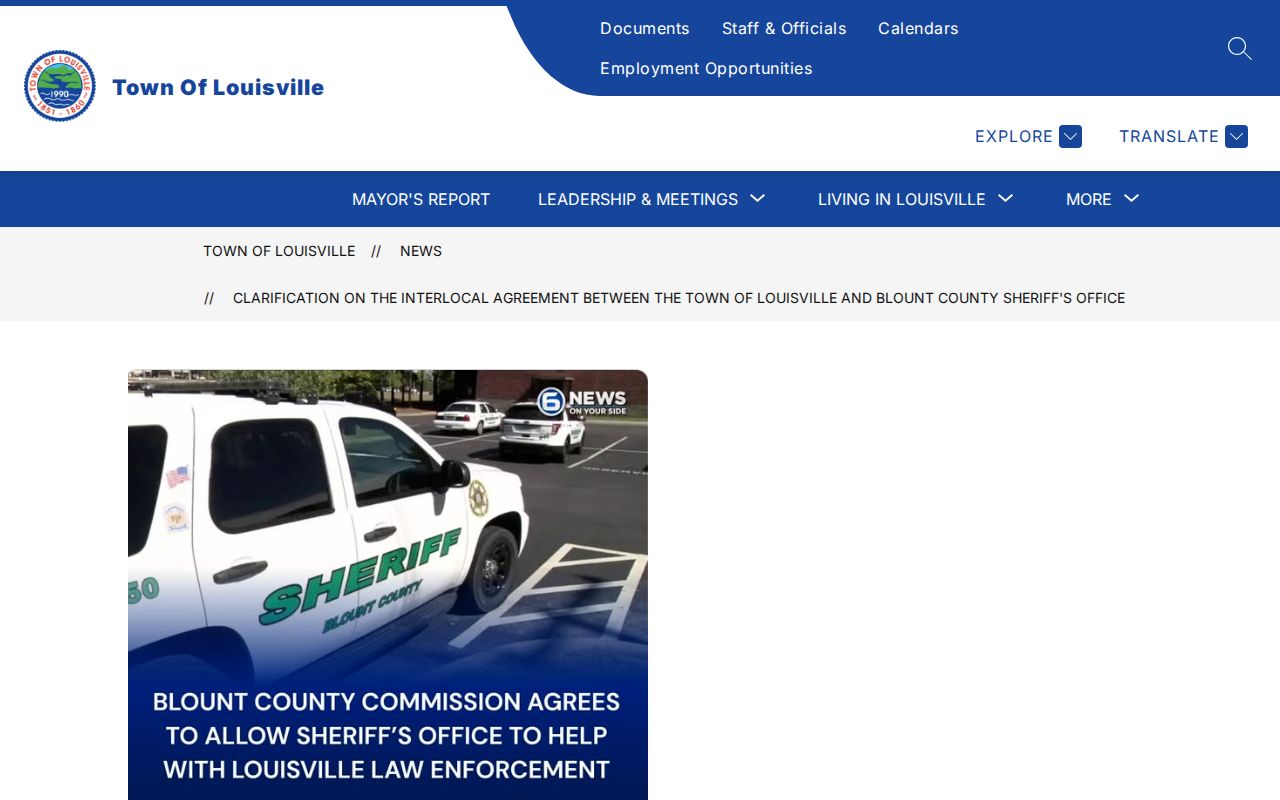
The notice describes coverage, not a warrant roster or court docket.
Louisville Town Hall and Warrant Contacts
Town Hall is at 3623 Louisville Road, Louisville, TN 37777, and answers at 865-681-1983. The town posts different public counter hours across the week, so confirm the day’s schedule before a trip. Its official pages do not name a standalone police department or publish a municipal warrant phone line.
When calling, explain whether the matter is a town ordinance notice, a county criminal case, or a request about sheriff service. Town Hall can route a local question; BCSO’s Court Support line is for county service matters.
Louisville Ordinance Fine Is Not a Warrant Bond
The March 2026 notice describes a maximum fine of $50 per violation for the town’s ordinance enforcement. That figure is a stated fine limit, not a bond amount, warrant fee, or promise that payment alone resolves a court matter.
Ask the record holder to explain what amount is due and what event it addresses. A citation, fine, court appearance, and warrant process are distinct. The notice does not provide a city payment portal or establish whether payment alone closes a case.
Use the official Louisville notice for the town’s published enforcement details.
Do not treat the ordinance fine limit as a warrant bond or assume that it resolves a court date.
Louisville City Warrant Types and Unknowns
Louisville’s public sources describe ordinance enforcement but do not publish a current court docket or warrant classification list. The table distinguishes what can be routed from what still needs Town Hall confirmation. It does not assert that a particular citation became a warrant.
| Warrant Type | How It Arises | Who Issues It |
|---|---|---|
| Town ordinance notice | Town says BCSO enforcement expanded; record route is not published | Ask Town Hall which office holds the citation |
| Traffic citation | Current Louisville court and payment route not confirmed | Town Hall can identify the custodian |
| Missed appearance | No public town process or schedule was located | Confirm with the office named on the notice |
| Criminal arrest warrant | Separate sworn criminal complaint and judicial review | Ask which issuing court is named on the paperwork |
Louisville Warrant Portal Has Not Been Published
The town’s official web material reviewed provides Town Hall contact information and a notice about BCSO coverage, but not a name-based warrant search. The absence of a portal does not prove there is no town process; it means the public route begins with staff who can identify the current holder.
Ask whether the record is held at Town Hall or by a court clerk. Request a case or citation reference and the next required step. No shared online Louisville docket was verified.
The town’s official site is the current contact starting point.

Use Town Hall to find the correct record holder before relying on an online result.
What a Louisville Warrant Record Should Confirm
Louisville publishes no warrant schema or sample city record in the sources reviewed. Ask Town Hall to identify the citation, the office or court holding it, and whether there is a later hearing, payment, or service event. The fields below are questions to take to staff, not claims about what appears on a public site.
| Notice or citation number | Copy the reference exactly; no public Louisville numbering pattern was found. |
|---|---|
| Name | Provide the name printed on the notice and ask staff to verify the match. |
| Ordinance / event | Ask which town rule and later action are recorded. |
| Record holder | Have Town Hall identify the current office or court clerk. |
| Amount | Ask whether it is a fine, court cost, or other amount; do not call it bond without confirmation. |
| Status | Request the current next date, payment instruction, or court action in writing. |
Louisville Warrant Notice Does Not Identify the Court
The 2026 notice explains police coverage and expanded ordinance enforcement, but it does not describe how a resident searches a citation, pays, contests a notice, or checks a warrant. Those missing steps matter: BCSO may provide enforcement while another office holds a town record.
When contacting Town Hall, ask for the name and number of the office that owns the docket and whether the notice has moved to a county court. Avoid paying a link found elsewhere until the town confirms it applies to the specific citation.
Use the published service notice for what it states, then ask Town Hall about the unlisted court steps.
A service contract is not a public warrant roster.
Louisville Warrant Questions and County Criminal Records
Louisville’s town notice describes BCSO law-enforcement coverage; Blount County General Sessions and Circuit Criminal maintain separate county court dockets. A town citation and a county criminal case are not one record. Tennessee has no public statewide warrant search.
Warrant flow: Louisville Town Hall identifies the local record holder › Blount County Sheriff for county service › no public statewide search
Use Blount County warrant records and the county search instructions when the citation or case names a county court. Ask Town Hall to route a town ordinance record.
Louisville Warrant Questions Need a Citation Holder
Since the town does not publish a separate police department or warrant portal, a person with a Louisville notice needs Town Hall to identify the current custodian. The BCSO service notice does not answer a town court date or payment question. Ask the office that holds the docket for a written statement of the next step.
Record the official’s name, case reference, and the stated hearing or payment instruction. If the town identifies a clerk or recorder, ask how that office wants a document request delivered.
Town Hall is reachable at 865-681-1983 during its posted counter hours.
Louisville Warrant Visits Depend on Town Hall Hours
Louisville publishes split public hours: Monday, Tuesday, and Thursday from 8:30 a.m. to 4:30 p.m.; Wednesday and Friday from 8:30 a.m. to 1 p.m. Those counter hours matter because the town has not published an online citation or warrant route. Call before visiting to ask which staff member can identify the record holder.
Town Hall is at 3623 Louisville Road, Louisville, TN 37777. A town contact page can help with directions, but it does not confirm the status of a citation or court process.
Use the Louisville Town Hall site to confirm current contact information before a visit.
Public Access to Louisville Warrant Records
A town ordinance record may be requested from the government office that holds it, subject to Tennessee public-records exceptions. Louisville has not published which office holds every citation or how to request a city docket, so first ask Town Hall for the custodian. Public access rules do not require release of confidential, juvenile, or sealed material.
Key Rules:
Tennessee Public Records Act (Tenn. Code Ann. §§ 10-7-501 et seq.) sets the general access right and statutory exceptions.
Ask Louisville Town Hall to name the department or court custodian before sending a public-record request.
Confidential, sealed, or juvenile records may be restricted; the custodian can explain what can be released.